Monday, May 16, 2022

Library Sale!


Harker Heights Library had a library sale on April 29th and 30th, 2022.   The Friday afternoon sale hours were from 4pm to 6 pm.  The Saturday sale hours began at 8 am and ended at 2 pm.  After 2 pm on Saturday, any remaining books could be had for free.  Like most events here in Central Texas, I anticipated one thing and got something completely different. 

Stewart C. Meyer Harker Heights Public Library serves a community of approximately 30,000 people.  The library has 42,650 volumes.  That’s a small library when you compare it to the Austin public libraries which register a total of 1,125, 099 volumes or Dallas with 4,131,672 volumes.*   The Harker Heights library is not the smallest in our area.  The sleepy town of Salado down the road has only 7,000 volumes.  Most home libraries top out at about 1,500 volumes.  One exception to that was Thomas Jefferson’s personal library which had approximately 6,000 books.  

In a library of 42,650 volumes, finding books is as simple as strolling up and down the aisles.  Unless you want to know for sure if the library has a certain book, there’s no need to hassle with the card catalog.  At the Harker Heights library, fiction books are found in the stacks in the center of the adult section.  History books are shelved at the far end.  Biographies are in the low shelves there to your right as you face the Fiction section.  New arrivals and foreign language books are up front as you enter.  For young adult literature and children’s books, keep walking back.  

Picking through books late on a Friday afternoon sounded like a relaxing way to end the week so I marked my calendar.  I normally stop in at the library every ten days or so.  Staff usually outnumber patrons.  There are on average two or three cars in the parking lot.  For the Friday afternoon sale, I figured I could get there anytime. I pulled in about 4:30 pm---and joined the line to wait for a parking space. 

If the Harker Heights Library has 42,650 volumes, then the Harker Heights Library Sale had 142,650 volumes.  The event room was buzzing.  People were everywhere.  At least 50 six-foot tables loaded up with books filled the room.  More books were beneath the tables in boxes. The number of popular fiction paperbacks was staggering.  The entire side wall was lined with tables of books labeled ‘Romance.’  Carts, tables and boxes were filled with books by James Patterson, Tom Clancy, David Baldacci and John Grisham.   Mary Higgins Clark was well-represented as well.  Her books were hard cover and in pristine condition.  That’s not to say this sale was all about popular fiction. There were other categories as well—history, military, biography, cookbooks, religion, self-help, mystery, suspense and plenty of fiction not written by James Patterson or David Baldacci.  There were CDs and movies.  Back in a far corner were about 20 lonely books marked 'Classics.'  This sale had it all.   

I dove in before it occurred to me to check prices. I had set a limit of $20, maybe five or six books, not more than ten.  It’s easy to get carried away at a sale.  The Hobby Lobby Effect (my coinage) sets in quickly.  Might I quickly explain? I had never been in a Hobby Lobby prior to coming to Texas, but briefly, what happens at Hobby Lobby is that as soon as you walk in the door and see that all the merchandise is on sale,** you immediately see all the items you’ve been looking for.  Not only that, but this immediately at-hand, sought-after merchandise takes on greater value because it is now a bargain. All the artificial plants and flowers in Hobby Lobby are perfect for those empty corners.  All the picture frames and vases and scented candles fit perfectly with your décor.  At Hobby Lobby, if you leave without buying, you are obviously a foolish shopper who doesn’t know how to save a penny.  

So, with the Hobby Lobby Effect in mind, I wanted to be careful.  I checked the prices. After all, I already have a home library of some 900 books that I’ve obligated myself to read.  I checked the prices again at another table. Finally, I asked.  Hardcovers were a dollar, paperbacks 50 cents and that was regardless of size or condition of the book.  Children’s books were priced from 50 to 10 cents.  It was essentially a give-away from the start.  

We all had our bags or boxes.  The library ladies supplied nothing except the books.  Some people had scanners and were assiduously checking out titles against re-sale prices I guess.  Others took photographs of entire tables.  Some carefully consulted hand-held lists or made phone calls as they went through a table volume by volume.  One shopper wore work gloves.  Mothers had brought kids in strollers and backpacks.  All the kids were crying. All the mothers ignored them.  Others of us searched for books, no grabbing, no jostling and no talking.  The library ladies tallied up your bill with pencil and paper.  For larger purchases they used a little handheld calculator.  Cash only, everybody!  The high school kids helping out had either serious faces or wore masks or both.  They alternately helped old people lug their purchases to their cars or they scooted out from behind closed doors carrying more books.  The room stayed packed until 6 pm.  I was there until the end and spent $4.50 and came home with 5 adult paperbacks and 5 children’s books. I knew when I left that I’d go back on Saturday morning.  

I got there about 10 am.  The tables were loaded up.  The number of books was the same or greater.  I swear to it. I didn’t intend to buy but I hadn’t seen all the children’s books so I dug in.  Saturday was obviously the day for the casual browser.  There were many fewer people, a lot of home schoolers with older kids, same old retired folk ambling about, but more young women, probably free of the kids for the morning while the husbands took over. Even with fewer shoppers, the pick-up trucks were lined up at the front door awaiting their owners’ boxes of purchases.  I bought a few more books.  My two-day spending total was $12.25, just slightly over half of the $20 limit I had set for myself. 

Now came the moment of truth.  Was I going to go back at 2 pm for the free-for-all?  We had a church festival to go to, dinner to plan. It was getting to be a warm afternoon and we had our granddaughters for the day.  They needed to run around for a couple hours at the playground.  I managed to get to the library just before 2.  

We lined up outside and once the bell tolled, we went inside.  Now the race was on.  Patrons were scooping books into their plastic bins at alarming rates of speed, seemingly indiscriminate in their choices. The library staff was in high gear doing the same. Empty boxes had suddenly appeared everywhere in the large event room.   As soon as one of the high school kids had cleared a table of books into a waiting box, another high schooler folded the table up and carted it away. The boxes were filling up quickly.  Neither side could get its books fast enough.  The room was humming.  It would seem this sale couldn’t end too soon for the librarians. One of them fairly flew past me with her sweater tails flying.  She was directing the high school kids who were pushing dollies of books in every direction.  I didn’t leave until the center of the room was cleared of tables. When I left, there were yet the 'Romance' novels by the hundreds waiting to be packed and carted off. 

All told, I came away with 45 books. Don’t be alarmed.  I spent not a dime over $12.25 so my cost per book was 27 cents. Not bad if you ask me, and, more to the point, I was careful.  Most of the books are soft-cover and most are children’s books.  A lot of these books will be happily read once or twice before they are moved along to other locations.  Some will get tossed but don’t tell.  I mean, for 27 cents……


Abigail and me with my 45 books.  

Among the 45 books are two prize purchases, Snippy and Snappy by Wanda Gag and Joan of Arc by Mark Twain.  The hardcover Snippy and Snappy is a reprint of the 1931 edition but I'm still happy with it. The soft-cover Ignatius Press edition of Joan of Arc by Mark Twain was stranded in the ‘Classics’ section before I rescued it.  Though a hardcover version might have been preferred, this book is in very good condition.  All this for $12.25!  I would have paid that amount for just these two books alone at that crazy antique bookshop in Salado!

 What a sale.  What a weekend. 


*The NYPL system has over 20 million volumes and the largest library in the world, the Library of Congress in Washington DC has some 170 million volumes.

**In my area, the Hobby Lobby 40%-off coupon option for your highest-priced item is no longer available.  


Friday, May 6, 2022

Reading History

My second video is up and running!  I hope you'll take seven minutes to pull up a chair and watch.  In addition, I've included a fun quiz for you to take!  I explain it in the video and it is also given below.


                                                                          FUN QUIZ      

Listed below are philosophers, intellectuals and thinkers who made major contributions to Enlightenment thinking and our modern age.  With one or two exceptions they all lived during the period covered by my recent timeline, 1300-1648.  As explained in the video, I continually confused these guys, one with the other and who influenced whom.  You cultured philosophes probably do not suffer from my welter of confusion, so, please put them in chronological order and let me know how you do!  As explained in the video, no books, computers, I-phones, maps, atlases, globes or references of any kind allowed.  This is a closed book, cold-turkey quiz that explores the accumulated knowledge in the corners (and "echoes") of your mind!

  1. Machiavelli
  2. Hobbes
  3. Locke
  4. Rousseau
  5. Voltaire
  6. Descartes
  7. Montaigne
  8. Montesquieu
  9. Pascal
  10. Erasmus
  11. Bacon (Francis)
If that doesn't appeal to you, here are some place names that, though not necessarily important locations, sent me running to the atlas.  Likely, the well-traveled eggheads among you will cruise through this list in seconds.  Same as above, no outside sources allowed. Let me know!

  1. Wallachia
  2. Bohemia
  3. Crecy (be specific)
  4. Tlemcen
  5. Otranto (be specific)
  6. Transoxiana~Transoxania
  7. Samarkand
  8. Styria
  9. Franche-Comte
  10. Moravia


Wednesday, April 27, 2022

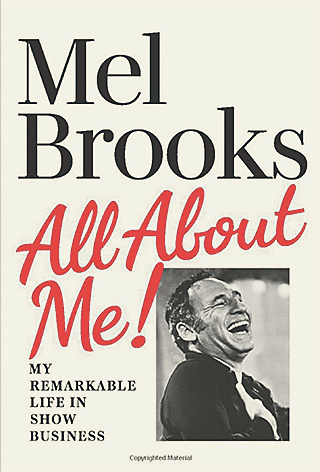
All About Me! by Mel Brooks

Are you a Mel Brooks fan?  If you are, you’ll certainly enjoy this autobiography of Mel’s life in show business.  If you aren’t a fan, you’ll still enjoy this autobiography of Mel Brooks, nee Melvin Kaminsky, and his life in show business.   

Mel Brooks says he had nothing to do during the pandemic, so he wrote a book!  The publication date is 2021.  Mel, having been born in Brooklyn in 1926, must have been somewhere around 94 as this autobiography came together.  The writing style is conversational.  The text includes song lyrics, jokes, favorite routines and dialog sequences that Brooks includes to illustrate various points.  There are a lot of pictures.  The 451 pages are organized largely according to Brooks’s artistic endeavors so a chapter on writing for TV and Sid Caesar, a chapter on Carl Reiner and the album the 2,000 Year Old Man, a chapter on Get Smart (had no idea that was Mel Brooks!), The Producers, Blazing Saddles, Robin Hood, etc.

Mr. Brooks does not dwell either excessively or introspectively on his personal life but he does offer occasional insights about how an event affected him or how a person helped to shape him.  He gives a pretty good accounting of his childhood, his early adulthood, and he does write about meeting Anne Bancroft, their marriage and life together.  His first marriage is not mentioned at all, although he has pictures of and writes warmly about his children from that marriage.

I admit to seeing none of Mel Brooks’s movies from start to finish, only snippets here and there.  I don’t think I was old enough or savvy enough to appreciate Mel Brooks in his early years, but as a baby boomer much of the culture that he writes about, entertainment and otherwise, is very familiar.  Brooks says his humor isn’t Jewish humor it’s New York humor, but what is New York humor if it isn’t Jewish?  In any event, until 1968, I knew little of New York, and I don’t think I would have been attracted to his work even if I had known more.  After reading this book, my favorite Mel Brooks movie would certainly be Blazing Saddles--the race jokes, the acting, the concept, just hysterical. 

After the first 70 pages or so, Brooks concentrates on discussing his work rather than his life except as it relates to his work.  He goes into some detail about what is involved in making a movie, selecting a cast, how writers write solo and how they write in a group, what it’s like to be the director and what it's like to take instruction from a director.  Brooks writes about what makes comedy work and the joy he gets from hearing the laugh.  He has a fairly exhaustive chapter on the Broadway production of The Producers.  He covers the business side of making movies and shows in the chapters describing his own production company, Brooksfilms.  I liked the insider looks at the entertainment business, life in California, his attempt to have John Wayne play the Waco Kid in Blazing Saddles, his friendships and professional relationships with Richard Pryor, Gene Wilder and Dom DeLuise among so many others.  

This book brings into focus Mel Brooks and his talent for doing just about everything—comedy writer, comedic vision, actor, screenplay-writer, songwriter, director, producer and did I leave anything out!  Mel Brooks frequently uses the adjective “Promethean” to describe others he’s worked with but I think the term could be applied to him as well.  Mel Brooks is a Promethean talent.  He’s intelligent, endlessly creative, articulate, analytical and funny. 

Brooks snuck a little bit of politics into the book.  When chosen for the Kennedy Center Honors in the earlier part of the 2000s, Brooks refused to accept the award from then-President George Bush.  He writes:  “I didn’t want to be honored by Bush because as a veteran I was very unhappy about Americans being sent to war in Iraq.”  Come on, Mel, just tell us you’re a Dem and be done with it.  A few years later in 2009 he accepted the same award from President Barack Obama.  

This book is not gossipy or fluffy.  Mel Brooks is a funny guy who is very serious about his comedy.  If you like reading about show business, comedy, Broadway or the creative process, Mel Brooks fan or not, it will be worth your while to read this book.  Democrat or not!

Frenchman's Creek by Daphne Du Maurier

“It is a pity you were not born a boy,” he said, “you would have discovered then what danger meant. Like myself, you are an outlaw at heart, . . . .”  A page or so along the pirate emphasizes the point, “It is a pity indeed you are not a boy, you could have come with me.”  So says our French pirate to the fair lady who meets his eyes above the embers of their dying campfire. 

Ah, there’s the rub.  What does a woman do if she is too independent-minded and too clever for the time and place in which she lives?  What does a woman do who longs to be more than her sex will typically allow? That is, in the words of Professor Higgins, why can’t a woman be more like a man? Of course, were the woman in question a man, our French pirate would not care a fig if he came along for the ride or not! Perhaps a woman should be a woman.  

Frenchman's Creek, Helford River, England
Our heroine, Lady Dona St Columb, is an upper-crust Brit in 17th century London.  She has a husband and two small children.  She gets involved with a dashing French pirate who parks his boat along the banks of a creek on her country estate.  While this plot line may seem a bit thin and contrived, the novel’s theme is neither.  This is a tale of star-crossed lovers!  Regardless of plot, thick or thin, who can resist a story of two people finding their soulmate only to find that soulmate to be just out of reach. 

 As in Mary Anne and My Cousin Rachel, Du Maurier’s female protagonist is not all that likeable.  Lady Dona is at first glance petulant and imperious, a bit abrasive.  As we read on, though, she acquires more dimension and depth.  She softens a bit.  Perhaps, we concede, perhaps she is just like anyone else, looking for true love.  Perhaps through no fault of her own she ended up with a husband ill-suited to her temperament.  Perhaps she should leave him?  Perhaps she should follow her dreams.  After all, don’t we all deserve to be happy?

About a third of the way through, I found the book hard to put down.  Du Maurier’s writing is expert, the setting is bucolic and remote.  The romance is high and the suspense is unrelenting!  The energy builds with the dopey husband, the dashing pirate, candelight dinners, the twists, the turns, the moonlit dramas and the sailing ship.  In fact, I’m not so sure that the excitement doesn’t continue right up until the closing sentence of the book.  Indeed, after reading the last word, I was disappointed to look up and see only my own living room and myself sitting there in a mere tee-shirt and sweatpants.  No silk gown, no candlelight, no creek and no pirate. 

What is the upshot of all this adventure?  Ultimately, it seems, men are daring and unafraid of being afraid.  Women are nurturers and naturally seek a safer harbor.  But you must read the book for yourself! Like Mary Anne and My Cousin Rachel this is probably more of a woman’s book.

Monday, April 18, 2022

Reading History

 My first video post!  I've just completed Will Durant Volume 6 of The Story of Civilization, The Reformation.


Tuesday, March 29, 2022

My Cousin Rachel by Daphne Du Maurier

My Cousin Rachel by Daphne Du Maurier

Daphne Du Maurier presents us with a story that is suspenseful, gloomy and creepy.  It is also a story of romance and probably a woman’s book.  Is Rachel vixen or victim?  Is she femme fatale or a plain Jane who is in the wrong place at the wrong time?

We have two protagonists in this story and two different settings.  Du Maurier contrasts Cornish, English country life with cosmopolitan, sunny Florence.  Phillip belongs to the former, Rachel to the latter.  Rachel is beguiling and bewitching, mistress of flowers and herbs, expertly brewing her tisanas for the enjoyment and health of all.  Philip is largely beguiled and bewitched, tending to his farm and tenants.  Then there’s Rainaldi hovering like a Dr. Faust in the background.  

Up to the very last line, Du Maurier creates an air of sadness and mystery.  Read this book with a cup of hot herbal tea close by. 

Mary Anne by Daphne Du Maurier

Mary Anne by Daphne Du Maurier

This is a great read, another woman’s book I’d say.  I really can’t see most men being all that interested in the tale of a smart and spunky lower-class girl of late 18th Century London who rises to fame as the mistress of H.R.H. The Duke of York.  There is plenty of intrigue, chicanery and affaires de coeur in this tale.

There is also, though, a tension, a dilemma.  What is an ambitious and clever young woman to do in the world of 1790 if she finds herself at the lower end of the social-class totem pole with a stepfather who falls ill, a mother who is worn out with the cares of life, a husband who turns out to be a ne’er-do-well drinker and four children to raise.  Mary Anne finagles and calculates to save herself.  Will she use any means necessary?  As a woman, is that her only recourse?  Is it only herself she looks out for?  Does Mary Anne ever really love anybody? 

Now, here’s the kicker.  Mary Anne Clarke is not a fictional character. She really was real and she really was the mistress of the aforementioned Duke.  Mary Anne Clarke was also the great, great grandmother of the author, Daphne Du Maurier.  I had not the slightest idea of this until I finished the book and looked up dates for the Duke of York just to better fix the story in an historical era.  Du Maurier makes no mention that her novel is a work of historical fiction.  Or is it?  But if it isn’t and it’s a biography, then shouldn’t it be introduced as such?  Only the dedication makes hazy reference to Mary Anne being a relative of the author. 

Du Maurier never gave a physical description of Mary Anne except through the voice of one male character.  He remarks that Mary Anne is not a beauty, yet there is something about her eyes.  It was clever of Mrs. Du Maurier never to supply a description of her historical main character when, certainly, she must have seen images of her relation.  I greatly enjoyed the omission; it kept me fully engaged, the imagination jumping from here to there, wondering just exactly what it was that made this woman so alluring. 

I came to like Mary Anne.  That is, for the most part.  In the midst of identifying with her and cheering her on, I would suddenly turn and conclude that she was all tricks and cagey antics, someone I’d never want for a friend.  If you haven’t read it already, read this book.  If you’ve read it, read it again.  Either way, it’s a delightful escape.    


Is this Mary Anne?

Is this Mary Anne?